
What is blackjack?
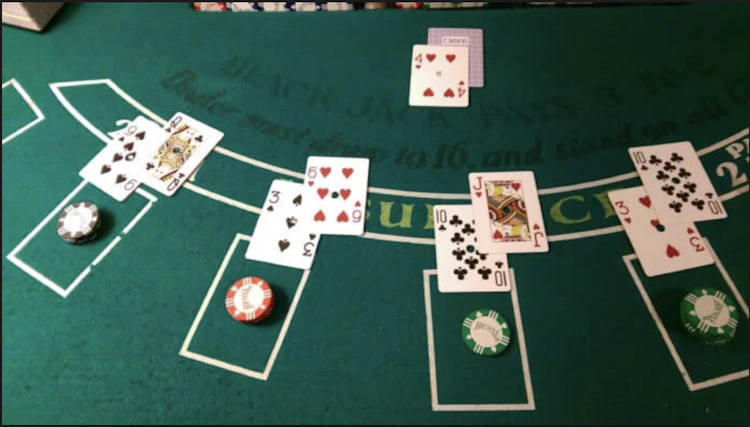
Blackjack, also known as 21, is one of the most popular table games in the casino industry. The rules are very simple, and the strategy is straightforward.
Blackjack history
Blackjack is part of a larger family of “twenty-one” card games. In France, the game was known as Vingt-et-Un (French for “21”), and versions of the game were played as far back as the 1760s. Over time, the game spread across Europe and became popular in the UK, before reaching the United States in the early 1800s.
The name “blackjack” is often linked to old casino promotions where certain “ace + jack” hands paid special bonuses.
Decks, the shoe, and the cut card
Blackjack is played with 1–8 decks, and many casinos use a 6-deck shoe (312 cards). When multiple decks are used, cards are usually dealt from a shoe, which lets the dealer deal one card at a time without holding the deck.
Casinos also use a cut card / plastic card placed near the bottom of the shoe. This signals when it’s time to reshuffle. The dealer does not deal all the way to the final cards, which makes it harder to predict what’s coming next.
“Permanent bank” (casino) vs home game
In casino blackjack, the dealer is the permanent bank, meaning the house is always the dealer. Players are seated, and the dealer stands and runs the game. In home blackjack, players often rotate as the dealer, but casino blackjack does not work that way.
How the game works
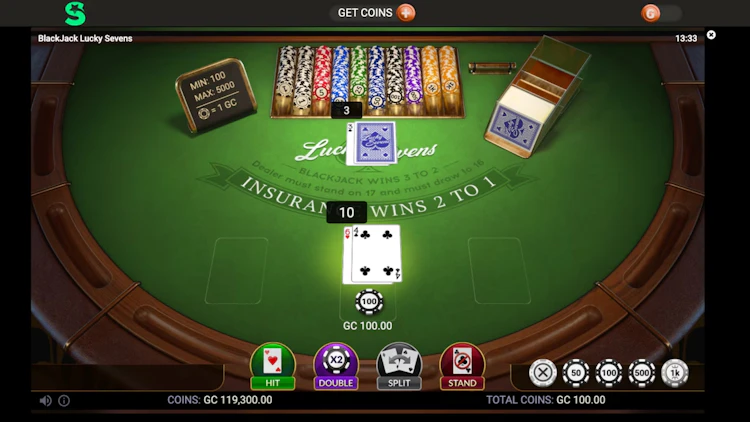
You will get two cards and the dealer will get two cards. Both of your cards are visible, while only one of the dealer’s cards is visible.
Card values
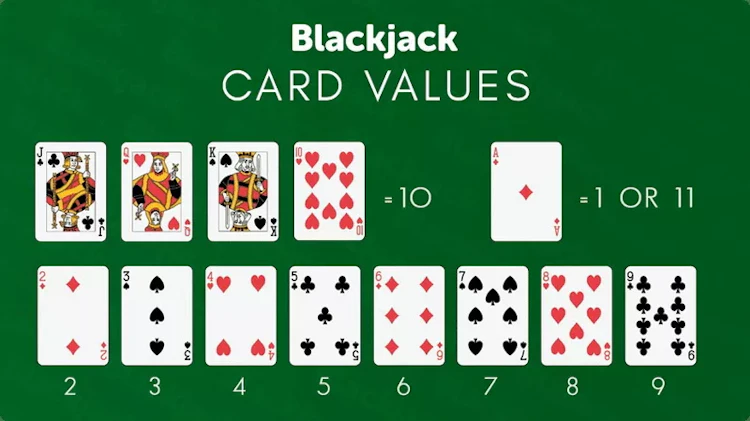
The card values are simple:
- Number cards keep their face value (for example, 1 of spades has a value of 1).
- Face cards such as queen, king, and jack are worth 10.
- Aces are worth 11.
Winning (and busting)
You will have the option to hit, stand, split, or double. Whoever gets closest to 21 wins the bet, but if you hit and bust, you will lose the bet immediately. An ace and a face card means an instant 21 (blackjack), which is an instant win unless the dealer also has an ace. In most casinos, blackjack pays 3 to 2. An ace also gives you less risk in your hand, as it can be used as a total or as a substitute.
Ace example (two possible totals)
Let me give you an example:
- If you have an ace and an 8, this can be a 19 or a 9. You can either stand and leave it as a 19, or if you hit, it will add onto the value of 9.
Dealer rules (what the dealer must do)
In blackjack, the dealer does not “choose” like the player. The dealer follows fixed rules:
- If the dealer has 16 or less, they must hit.
- If the dealer has 17 or more, they must stand.
Hole card vs no hole card blackjack
This is one of the most important “table rule” differences, especially in live casino.
Hole card blackjack
In hole card games, the dealer takes a second card face down immediately. If the dealer’s upcard is an ace or a 10-value card, the dealer may “peek” to check for blackjack right away. If the dealer has blackjack, the hand ends immediately.
No hole card blackjack
In no hole card games (common in Europe), the dealer does not take the second card until after players finish their decisions. This changes the risk in some situations, because if you double or split and the dealer later reveals blackjack, you may lose more money than you would in a hole card game (depending on the rules). In simple terms: no hole card makes some aggressive moves riskier against a dealer ace or 10.
Blackjack actions
Below are the actions taken in the game of blackjack:
Hit means you choose to take one more card on top of your starting two cards. You can hit many times as long as you don’t go over 21 in total card value, or else you will bust.
Stand means you choose to hold onto your cards and wait for the dealer to reveal their hand in order to know whether you win or lose.
After receiving your two cards, you can decide to double. This means that you double your wager, but after you double, you cannot hit to get more cards.
When you receive your cards, if they are both the same value or both face cards, for example:
- two aces
- two eights
You can choose to split. This means that your cards will each receive another card and will be played independently as separate hands. Doing this means that you will have to double your wager, so the wager is split between the two hands. In some variations of blackjack, you are allowed to split more than once, which means after the first split, if you get the same number or value again, you are allowed to split again.
When the dealer has an ace, you will be given the option of insurance. This costs half your bet and gives you the option to play it safe in case the dealer gets a blackjack. This means that if you accept insurance and the dealer ends up having a blackjack, you will get paid double the insurance. If the dealer doesn’t get a blackjack, you will lose the insurance money and the game will continue with what was wagered at the start.
Some blackjack tables offer surrender. This lets you give up the hand immediately and lose half your bet, instead of playing the full hand.
- If you surrender a ₱100 bet, you lose ₱50 and the hand ends.
- Not all tables offer surrender.
- It is usually not allowed after splitting, and many casinos only offer “late surrender.”
Surrender is mainly used on the worst hands where playing normally is statistically even worse.
Blackjack payouts (3:2 vs 6:5)
You already mention the classic payout: blackjack often pays 3:2. That is the standard payout you want.
However, many casinos now offer worse payouts:
- 6:5 blackjack (much worse for the player)
- 1:1 blackjack (usually on some online/video variants)
This is one of the biggest “quick checks” in blackjack: If you care about better odds, choose 3:2 tables whenever possible.
How results are settled (push, dealer bust, blackjack priority)
After all players act, the dealer completes their hand. Then outcomes are decided:
- If the dealer busts, all players who haven’t busted win.
- If the dealer doesn’t bust, the higher total wins.
- If totals are the same, it’s a push / stand-off (your bet is returned).
- A blackjack beats any 21 that is not a blackjack.
- If the dealer has blackjack, all players without blackjack lose (blackjack vs blackjack is a push).
Blackjack basic strategy
In this section we will outline how to play blackjack perfectly. When the dealer’s face-up card is a 7, 8, 9, or 10, you should not stop hitting until you get 17 or more. When the dealer’s card is a 4, 5, or 6, you should stand and wait for them to bust. When it’s a 2 or 3, it depends on which cards you have. Below is a picture of the perfect blackjack strategy:
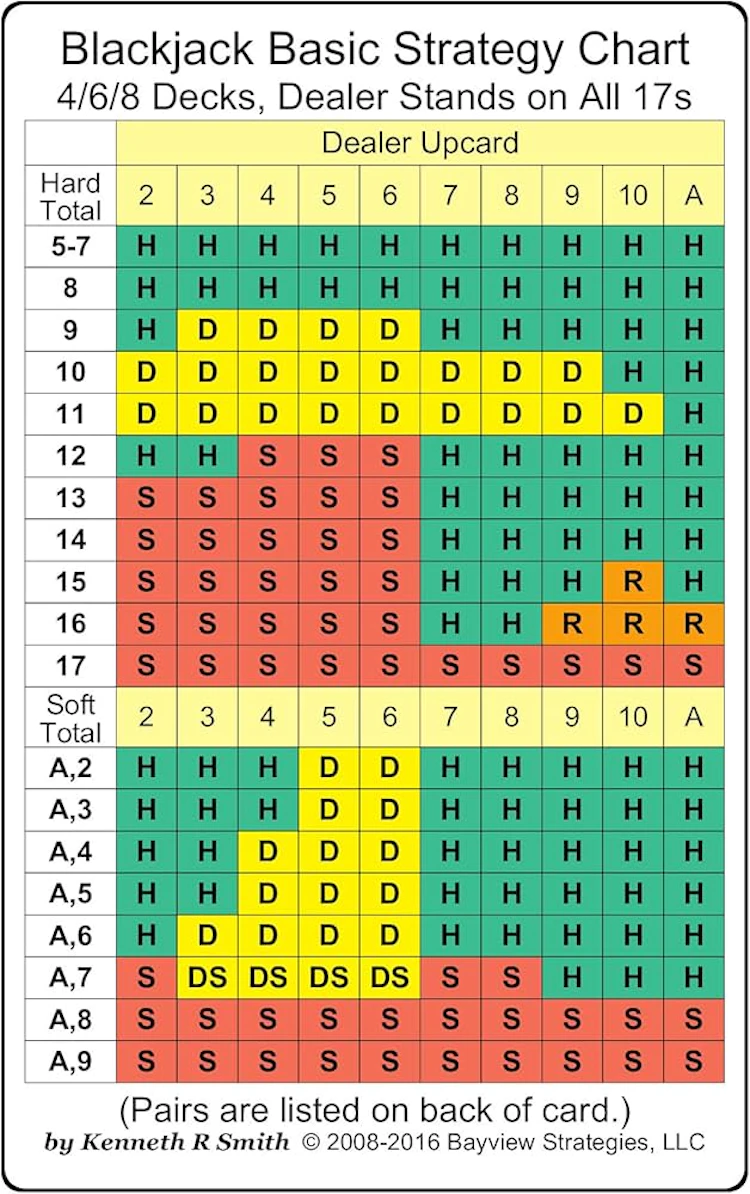
When to double?
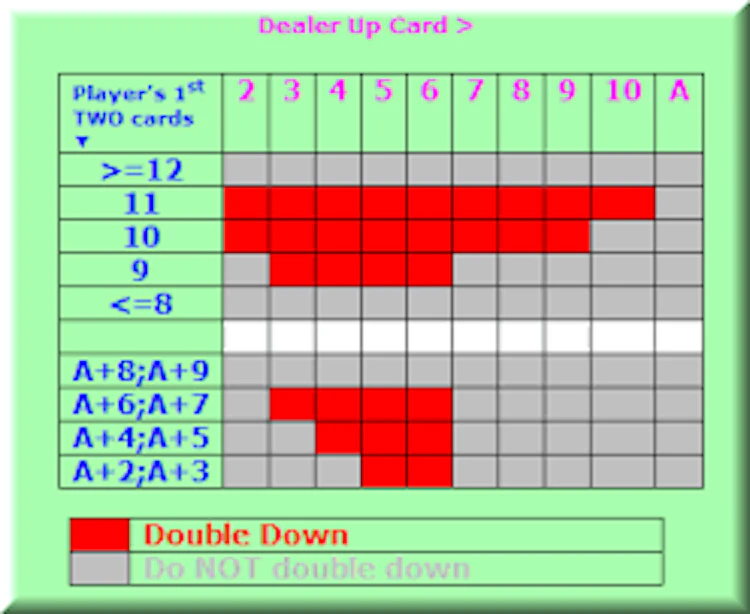
Doubling can give you better potential winnings, but this depends on whether you play it right. Doubling can be good in many instances, but it depends on the cards you are facing and whether you are willing to take the risk.
Always double when you have an 11, as this is the best opportunity to double since any card won’t bust and there is a big chance of getting a 10, which means you get an instant 21. Many players won’t double an 11 if they’re facing a 10, since the chance of the dealer getting 20 is high, so doubling can seem risky, but this depends on the player’s play style.
You can also double when facing a 4, 5, or 6 if your total is less than 11. This gives an extra chance of winning since the chance of the dealer busting is already high. Don’t double when you have 2, 3, 4, 5, 6, 12, 13, 14, 15, 16, 17, 18, 19, or 20, as the chance of getting close to 21 here is very unlikely. Many players also like to double on an ace as this gives you two different values; this is ideal when the dealer has a 4, 5, or a 6.
Below is a picture of the perfect double strategy in blackjack:
When to split?
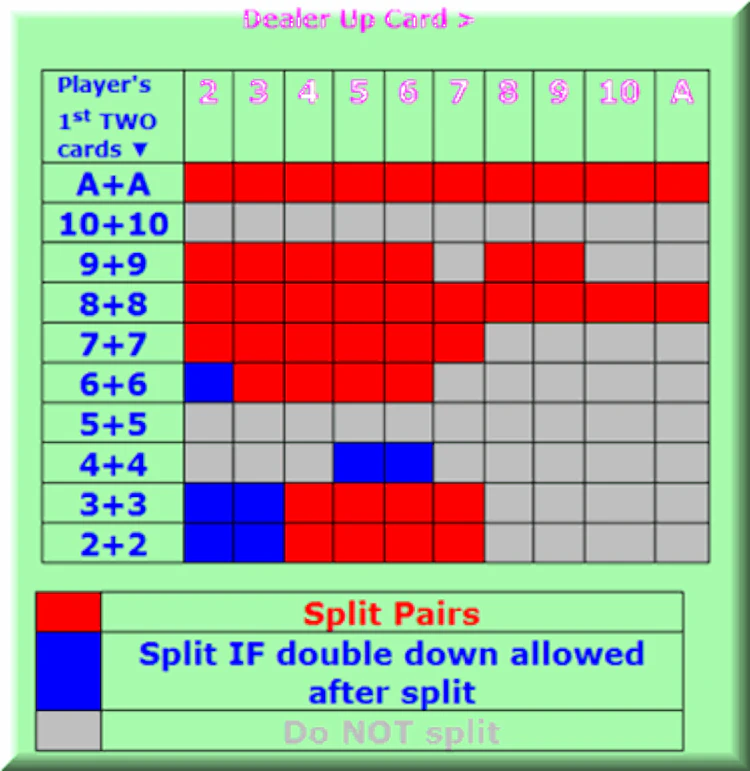
Splitting can also double your wager and give you better winnings, but timing matters a lot depending on what you are facing.
The best example of splitting is when you get two aces. This is ideal as it gives you the potential opportunity of two blackjacks if it plays perfectly, and if not, you still have an extra chance since an ace counts as two different values. Nines are also ideal to split, as if played perfectly both hands can get a 19, which is very close to 21.
There are many different variations of when to split and when not to split. This always depends on risk tolerance, and whether you want to play blackjack by the book or not. Below is the perfect rule book of when you should split:
Basic strategy: what your section is missing (soft hands + pairs)
Your current basic strategy is a great starting point, but full basic strategy also includes:
Soft hands (ace hands)
A “soft hand” is a hand with an ace that can count as 1 or 11 (example: A+6). Soft hands are played differently because you can often hit safely without busting immediately.
Pairs (splitting strategy by dealer upcard)
Splitting is not only about “good pairs.” In basic strategy, the correct split depends on what the dealer is showing. Some pairs are almost always split (like aces), while others depend heavily on the dealer’s upcard.
Why strategy changes slightly
Even perfect basic strategy changes slightly depending on table rules, such as:
- number of decks
- H17 vs S17
- surrender rules
- double-after-split rules
Common rule variations that affect the house edge
Blackjack rules vary by casino, and small changes affect how good the game is for the player. Common examples include:
- Double after split (DAS) allowed or not
- Re-splitting rules (and how many hands you can split into)
- Split aces restrictions (often one card only, and no hitting)
- Double allowed only on 9/10/11 (Reno rule)
- Original bets only (OBO) in some no hole card games (optional bets like doubles/splits may be protected if the dealer has blackjack)
- Dealer wins ties (rare but extremely bad for players)
Side bets
Side bets are bets you can place alongside your original bet on your cards. The most common side bets consist of Pair or 21+3. There are many more variations in other blackjack games.
Pair
What it is
You will bet that the first two cards you are dealt will be of the same value.
Examples that win
- You get 8♠ + 8♦ → wins (pair of 8s)
- You get K♥ + K♣ → wins (pair of Kings)
Most common payout table
Casinos usually pay different amounts depending on how “perfect” the pair is:
- Mixed Pair (same rank, different colours) — e.g., 8♠ + 8♥ → pays 5:1
- Coloured Pair (same rank, same colour, different suits) — e.g., 8♥ + 8♦ → pays 10:1
- Perfect Pair (same rank, same suit) — e.g., 8♠ + 8♠ → pays 30:1
Simple payout example
- If you bet ₱100:
- Mixed Pair → win ₱500
- Coloured Pair → win ₱1,000
- Perfect Pair → win ₱3,000
(Plus you usually keep your original ₱100 bet as well, depending on how the casino displays “win” vs “payout.”)
21+3
What it is
You’re betting that your two cards + the dealer’s upcard (the one dealer card you can see) will form a 3-card poker hand.
Examples that win
Flush (all same suit):
- You: A♠ + 7♠, Dealer upcard: K♠ → Flush
Straight (3 in a row):
- You: 5♦ + 6♣, Dealer upcard: 7♥ → Straight
Three of a kind:
- You: Q♠ + Q♦, Dealer upcard: Q♥ → Three of a kind
Straight Flush (straight + same suit):
- You: 10♥ + J♥, Dealer upcard: Q♥ → Straight Flush
Most common payout table
A very common payout set is:
- Flush → 5:1
- Straight → 10:1
- Three of a Kind → 30:1
- Straight Flush → 40:1
- Suited Three of a Kind (Suited Trips) (rare, only on some tables) → 100:1
Simple payout example
If you bet ₱100:
- Flush → win ₱500
- Straight → win ₱1,000
- Three of a kind → win ₱3,000
- Straight flush → win ₱4,000
- Suited trips (if offered) → win ₱10,000
Advantage play (optional knowledge section)
Some players try to gain an edge using advantage play, especially card counting. Card counting is legal in many places, but casinos can still refuse service or ban players.
Card counting works best in games with fewer decks because the remaining card composition becomes more predictable. That’s one reason casinos use:
- multi-deck shoes
- cut cards (not dealing to the bottom)
- shuffling machines
These tools reduce predictability and make counting less effective.
Where to play Blackjack in the Philippines?
Below are some of the most popular casino sites in the Philippines which offer blackjack:








 8
8 Blackjack variations (common versions you’ll see)
Blackjack FAQ
